
ENGINEERING THE DIFFERENCE
A FUNDAMENTALLY DIFFERENT UV-C ARCHITECTURE
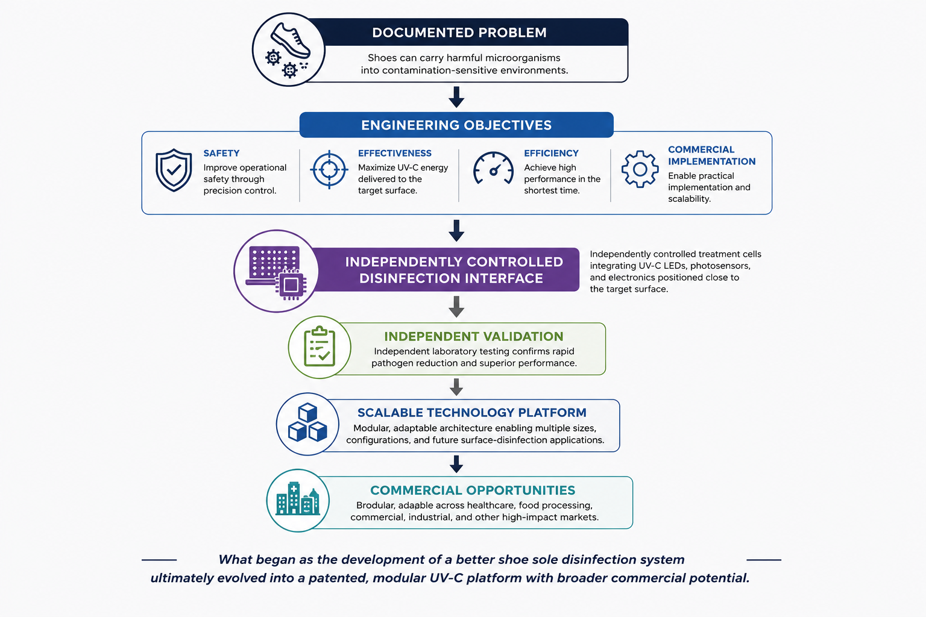
Infinite Shield was developed to solve a demanding engineering challenge: deliver sufficient UV-C energy to rapidly disinfect a contaminated surface while precisely limiting activation to the covered treatment area. Meeting this challenge required a fundamentally different approach to emitter selection, optical sensing, electronic control, and overall system architecture.
The result is a patented Digital Shielding architecture and modular surface-disinfection platform engineered around three priorities: user safety through precision, effective and efficient treatment, and practical commercial implementation.
ENGINEERED AROUND THREE DESIGN PRIORITIES
SAFETY THROUGH PRECISION
Digital Shielding limits UV-C activation to treatment cells covered by the target surface, reducing the potential for direct UV-C exposure while enabling precise, localized treatment.
EFFECTIVE AND EFFICIENT TREATMENT
A dense array of UV-C LEDs positions germicidal energy close to the target surface, increasing available irradiance at the treatment interface and supporting rapid pathogen reduction with short exposure times.
PRACTICAL Commercial IMPLEMENTATION
A compact, modular architecture built around board-level components is intended to support practical prototype development, scalable manufacturing, and adaptation to multiple surface-disinfection geometries and applications.
The Breakthrough: Cell-Level Digital Shielding
The defining engineering breakthrough behind Infinite Shield was the development of a dense grid of independently controlled treatment cells. Each cell integrates a UV-C LED, optical sensing, and supporting board-level electronics, allowing the system to identify the area covered by a target surface and activate only the corresponding cells.
This transition from separate shielding approaches to localized digital control substantially improved treatment precision, safety, performance, and adaptability. More importantly, it established the patented Digital Shielding architecture that differentiates Infinite Shield and provides the foundation for a compact, modular, and scalable surface-disinfection technology platform.
PRECISION DIGITAL SHIELDING
The following demonstrations illustrate the patented Infinite Shield operating principle at the treatment-cell level: optical sensors identify the covered area, the control system continuously tracks the target’s position, and only the corresponding UV-C LEDs activate.
PRECISION TARGET DETECTION
Photosensors detect the outline and position of the target surface.
DYNAMIC SURFACE TRACKING
The active treatment pattern adjusts as the target moves across the interface.
INDEPENDENTLY CONTROLLED ARCHITECTURE
Each treatment cell integrates sensing, UV-C emission, and localized electronic control to support precise activation.
ENGINEERED FOR A SCALABLE PLATFORM
The Infinite Shield architecture is not confined to a single shoe-sole disinfection format. Treatment-cell arrangement, grid geometry, enclosure design, power density, and control logic can be configured around different surface geometries and operating environments.
MODULAR GRID GEOMETRY
Treatment cells can be arranged across different dimensions, planes, and target areas.
COMPONENT-LEVEL FLEXIBILITY
The architecture can incorporate continued improvements in UV-C LEDs, optical sensors, controls, and board-level electronics.
APPLICATION-DRIVEN CONFIGURATION
The platform can be repackaged around the contamination-control requirements, installation constraints, and operating workflow of a specific market.
Advancing Toward Commercialization
Nittany Solutions Group has established the patented architecture and independent performance foundation for Infinite Shield. The next phase requires strategic collaboration to advance application-specific prototype development, OEM integration, and future commercialization.