
INDEPENDENT TESTING VALIDATION
Rapid Pathogen Reduction Across Diverse Microorganisms
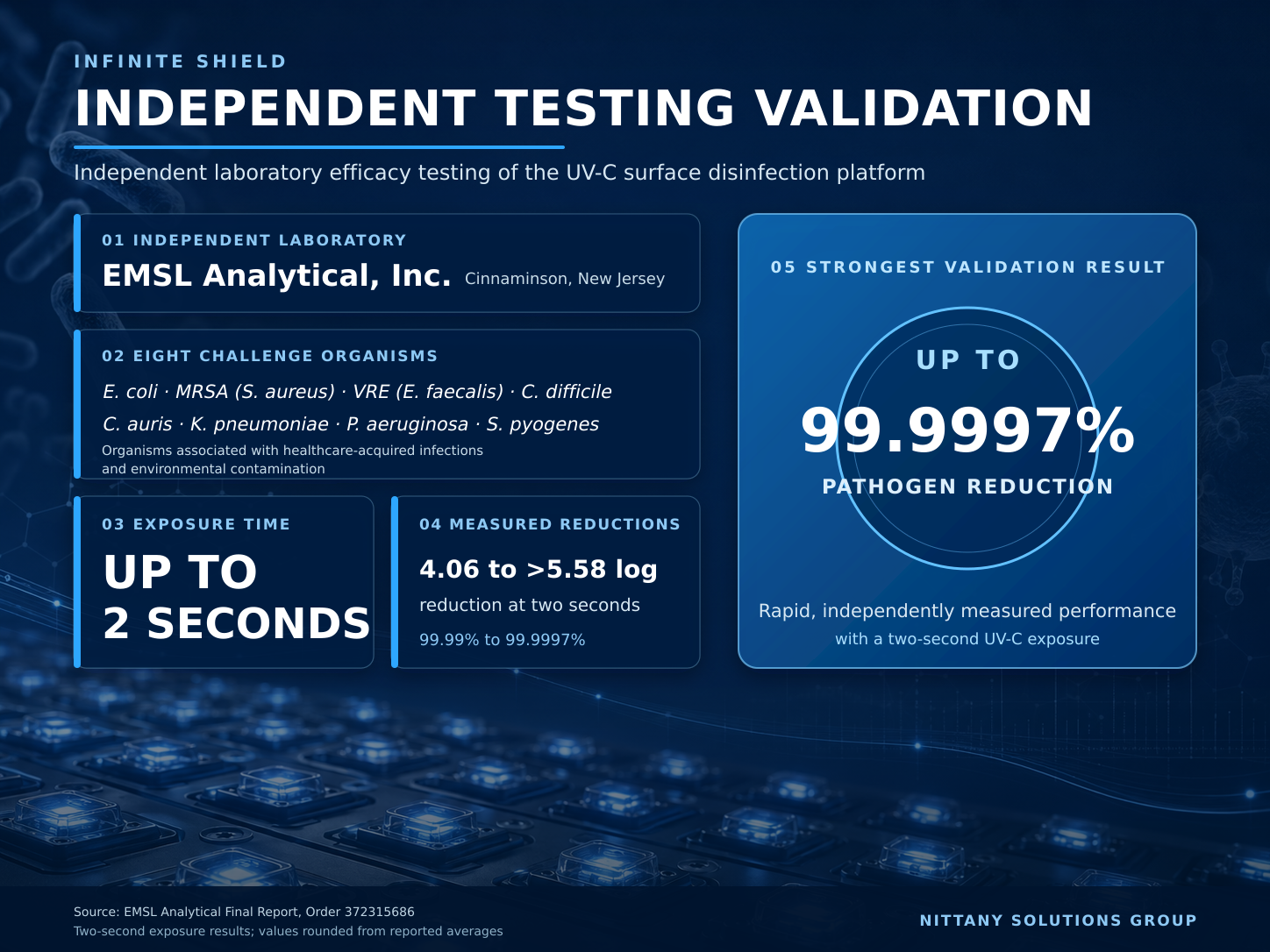
Nittany Solutions Group commissioned EMSL Analytical, Inc. to independently evaluate the pathogen-reduction performance of the Infinite Shield surface-disinfection interface.
The study evaluated eight microorganisms relevant to healthcare-associated infections and food safety at exposure times of two and six seconds, with three replicated trials conducted for each test condition.
The results established that the Infinite Shield architecture can deliver rapid, measurable pathogen reduction across a diverse group of challenge organisms, providing an independent performance foundation for continued engineering development and broader platform adaptation.
TWO-SECOND PERFORMANCE
At the two-second exposure time, measured reductions across the tested organisms ranged from 4.06 log to greater than 5.58 log. The strongest validated result reached up to 99.9997% pathogen reduction.
UNDERSTANDING LOG REDUCTION
Log reduction expresses disinfection performance on a base-10 scale. Each additional log represents another tenfold reduction in viable microorganisms: 2-log equals 99%, 3-log equals 99.9%, 4-log equals 99.99%, and 5-log equals 99.999%.
Because pathogen populations may number in the millions, small numerical changes in log reduction represent substantial differences in remaining viable organisms.
EIGHT CHALLENGE ORGANISMS
Escherichia coli (E. coli)
Staphylococcus aureus (MRSA)
Enterococcus faecalis (VRE)
Clostridioides difficile (C. diff)
Candida auris (C. auris)
Klebsiella pneumoniae (CRKP)
Pseudomonas aeruginosa
Streptococcus pyogenes
PERFORMANCE DRIVEN BY ENGINEERING
Pathogen reduction depends on delivering the appropriate germicidal UV-C dose to the target surface. That dose is governed by wavelength, irradiance at the treatment interface, exposure time, and the uniformity of energy distribution. Infinite Shield was engineered to optimize these interdependent variables rather than relying on prolonged exposure from a small number of remotely positioned lamps.
Dense UV-C LED Array: Hundreds of closely spaced solid-state emitters distribute UV-C energy across the treatment surface. Positioning this dense array near the target increases irradiance at the treatment interface, minimizes the energy losses associated with distance, and reduces low-intensity areas that can occur between widely spaced light sources. The result is more uniform energy delivery and the ability to achieve an effective germicidal dose within a substantially shorter treatment period.
Optimized Wavelength and Controlled Emission: Infinite Shield employs UV-C LEDs selected to emit near the wavelength range most efficiently absorbed by microbial genetic material. This increases the effectiveness of the delivered energy in disrupting microorganism replication. Unlike low-pressure mercury lamps, the LEDs activate at full output almost instantly, allowing treatment to begin immediately and enabling precise electronic control of exposure timing at the individual-cell level.
Solid-State Durability and Service Life: UV-C LEDs eliminate the fragile glass envelopes, mercury content, and warm-up requirements associated with conventional low-pressure mercury lamps. With rated operating lives potentially eight to ten times longer, the solid-state emitters are well suited to frequent activation and high-volume use. Their durability also supports a compact, modular architecture with reduced maintenance requirements and more predictable long-term operation.
COMPETITIVE PERFORMANCE CONTEXT
The Infinite Shield results can be compared with published performance data for two commercial shoe-sole disinfection systems. Those systems report exposure cycles of approximately six to eight seconds, while Infinite Shield achieved its independently measured two-second results in a fraction of that time.
The comparison provides useful market context but is not a head-to-head laboratory study under one common protocol. Test organisms, starting concentrations, recovery methods, and reporting thresholds may differ among published datasets.

SOURCE DOCUMENTATION AND SCIENTIFIC FOUNDATION
Review the complete independent laboratory report for test conditions, organism-specific results, and reported calculations.
The broader scientific foundation includes peer-reviewed hospital studies, government research, and supporting literature addressing footwear contamination, environmental transmission, UV-C efficacy, and surface-disinfection practice.